

In this episode:
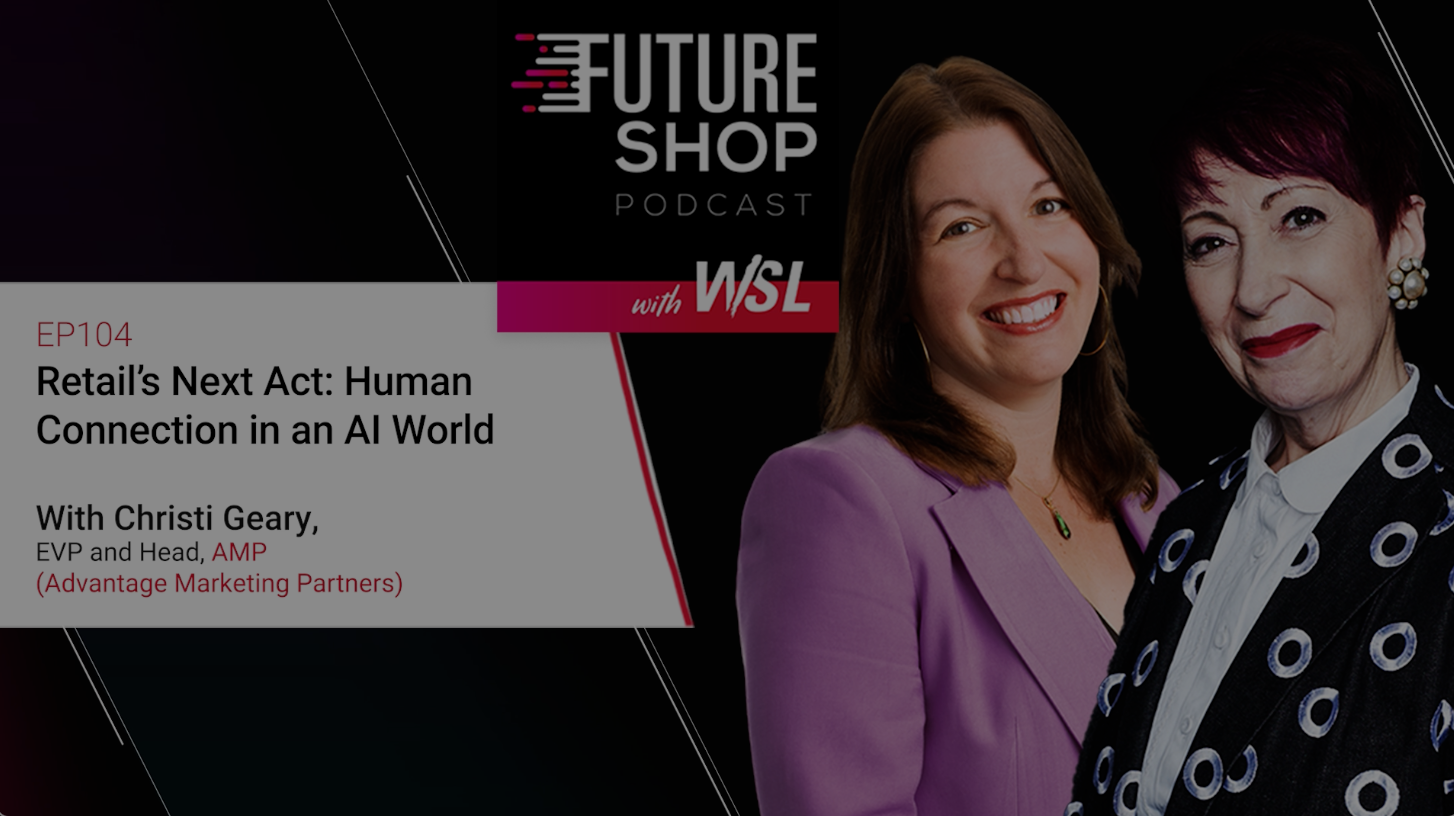
In this episode, Wendy Liebmann sits down with Christi Geary, EVP at Advantage Marketing Partners, to explore the evolving landscape of retail and the enduring power of the human connection. They dive into the intersection of technology and emotion, discussing why physical retail remains vital despite the digital explosion and how brands must shift from simple execution to true transformation. Geary shares her unique perspective on breaking through the “mediocrity middle” by leveraging behavioral science and proprietary points of view to create harmonious shopping experiences.
Episode highlights:
- The Attention Economy: Why breaking through the noise has become a different task in the age of constant technological shifts.
- Physical Retail’s Reinvention: Why the “race for reinvention” stalled and how retailers can tap into the human thirst for physical connection.
- AI as Augmentation: Moving beyond mere efficiency to use technology as a tool for enhancing the human shopping journey.
- Systems Over Silos: The necessity of breaking down corporate barriers to create a cohesive, shopper-centric ecosystem.
Chapters:
01:43 – Market Shifts: Technology, Attention Spans, and Retail Constant
07:18 – The Future of Experience: Reinventing Physical Retail
12:52 – AI and Human Creativity: Enhancement Over Efficiency
21:27 – Modern Category Management: Seeing Beyond the Silos
33:45 – Strategic Takeaways: Systems, Transformation, and Holiday Markets
Don’t miss upcoming episodes, subscribe to our podcast with your favorite app.
Watch the video episode:

Wendy L. 00:00 Hello, everyone. I'm Wendy Liebmann, CEO and Chief Shopper at WSL Strategic Retail, and this is Future Shop. This is where I talk to innovators, disruptors and iconoclasts about the future of retail. My guest today is Christine, also Christi Geary. She is the EVP at Advantage Marketing Partners. She's going to tell you a bit more about that in a minute, She has a very unique point of view about the future of retail, the future of shopping, and that just broad of view from her various purviews, at P&G, where she and I first met on the insight side of the business, at Bayer, where she created a whole omni channel platform of marketing. And in her current role, she has this unique point of view about where retail consumers and shoppers are going. So perfect for this discussion. So welcome Christi. Christi 01:09 Thank you Wendy, and thank you so much for having me. You and I both know it is not a hardship for us to have conversations. We could do it all day. So I appreciate you giving us the opportunity to do it formally, Wendy L. 01:20 and before I begin the conversation with Christi, please don't forget to subscribe to the podcast. Wherever you get your podcast. Just click there to subscribe and we'll know you're there. Thanks for that. And now on to the conversation. Tell everybody a little bit about what it is you do. Christi 01:43 so absolutely a lead the AMP agency, which is, as Wendy said, Advantage Marketing Partners, and it is an affiliation with Advantage Solutions. But ultimately, we are an extraordinary agency that is the, we'll call it, integration of 10 plus previous agencies that has come together to offer a model, if you will, that reflects both where the world is going and, more importantly, what it needs. And we're doing it in a way that really helps us understand the shop or human aspects, and more importantly, all of the realities of the technology and the retail that are playing constantly evolving roles in our lives. Yeah, and my not so day job, that is a constant every minute job is as a lovely working mom, and focused on that quite extensively. Wendy L. 02:31 So Christi showed up again in my life a year or so ago. She and I first met when she was very involved Procter & Gamble. And we were doing a lot of work, and shopper insights disappeared from my life and or our life at WSL. And all of a sudden we were doing an immersion with Kroger, regular immersions that we do with retailers, as most of you know. And all of a sudden, there she was under Bayer. So it was great to to re engage with you in the work you were doing there. When I step back for a minute and think about over those years, the biggest shifts, and what are the things that just haven't changed at all? Christi 03:26 So biggest shifts are going to be way too obvious, right? It's going to be technology. Technology keeps shifting under our feet, but at the same time, it's kind of all the same. I will tell you, a lot of people think that ARM came out of nowhere, and that it was something we've never seen before, I would argue that it follows the same model as the loyalty card data and the same type of life cycle that we're seeing in all those places, and we'll probably see very shortly here in ChatGPT and AI and all the other pieces, they just become an integral part of all the different pieces that make up what We are. So technology is a constant shift, and it's one that if you are unprepared or unwilling to engage, then you just honestly shouldn't be playing the game, because it's too hard to do that. I think the other big shift, and I think this is the one that is most challenging for those of us who really love the true art of marketing, and that's attention span. Because of the rise of technology, because of all these other components, truly figuring out how to break through and create relationships with people has become a very different task and a very different ask, over the nature of what we do, and then in terms of what hasn't changed, and there's so many things that have and hasn't, I think retail, interestingly enough, has not changed that much. Where all you buy, being able to buy everywhere, that's 100% changed. Everything is now shoppable, but retail and itself in especially in a physical environment, is still a very specific experience. The trick now is connecting that to the plethora. Era of places where you can now buy in what shape or form and how you can opt in and out of the actual experience. And I don't, and I think the humans, the humans haven't changed, just the attention span, yeah, Wendy L. 05:13 You know what what strikes me about what you just said? And it is a, it's a huge worry that I have in my, you know, work life, in our work life at WSL, is that the fundamentals, the human nature of the people who buy our goods and services, that Maslow's hierarchy, if you will, which I seem to keep talking about lately, if anybody knows, what the hell, and that's how we Christi 05:39 the hell. And that's how we first started talking with each other. Wendy L. 05:43 Remember, right? So the things that we need to feed our family, to take care of our family, to feel great wear today, color our hair, all those things, nails, you know, the quality of that, or the or the fundamental, the foundational elements of that, are still so important to us all, and that hasn't really changed the aspects of how we do that and how we engage in that, to your point, have changed absolutely and the implications of those hows on, as you said, how much time, how much attention we get, all of those things. What worries me in all of this is the fact that physical retail, for the most part, hasn't changed a lot. I grew up in the bush in Australia. I can tell you what a pharmacy looked like, aka drug store. I can tell you what the local discount, you know, supermarket place look like, the department store in Sydney was that we I went to with my grandmother on holidays, and we went to lunch, things like that. I could come from the planet Mars and drop in and I'd be like, oh, yeah, I get it. Okay, yeah, fine. Looks about right. Looks very familiar. And yes, we all know that the way we buy has changed so much. And I worry that retailers getting to the crux of things already with you, that retailers look at the familiarity and think, oh, no, no, that's I get that. I get that. And they don't understand that the shop was so far ahead and so much in that on their journey and the way they approach it. So am I worried unintentionally? Or do you feel the same way? Christi 07:18 No, I think. I don't think I fall into the worry bucket. I think I fall into the potential disappointment bucket, mostly because there's still always going to be a place for physical retail, humans still need that actual connection. Digital is going to continue to accelerate, and it will, as you're seeing it across the board, but physical for a while there, there was the Oh, physical is going to disappear. We'll never need it again. I think we've answered the question that physical will not disappear. What we haven't done is then embraced that as an opportunity to truly reinvent, to truly figure out how to make this an experience to your point that you could drop in from another planet and be like, this is pretty cool, as opposed to this is the same thing I'm used to all the time. The race for reinvention stopped back in the early 2000s having worked on a number of store reinventions and experiential components in early days of my career. Was so exciting because there was an opportunity with physical retailers to actually figure out how you would make that experience different. And that investment stopped about the time the digital started to accelerate. And I think we are long overdue for a balancing of the effort and the creativity in the space of, how do we start to transform both aspects in a world of shoppable everything? Wendy L. 08:35 Yeah, and you're so right in that. I mean, I actually think it's one of those moments that, you know, we sort of stand on the quote, unquote, precipice of such exciting things when it comes to all the ways we connect, the way as shoppers and people who buy from us want to buy things, and that I've been using the over overused term ecosystem a lot, which please give me another one, but that sort of embrace of that, that world of shopping, and it's really fascinating to me to think about who's going to step out as a retail company, who's going to step out and do that? I think you've got young kids. You've got what, 19 year old kids, right in college, yes. Christi 09:20 So I've got freshman in college and a sophomore in high school. Okay? Wendy L. 09:24 So when you look at them, and you think even the two different ages of those kids, not children anymore, and the way they choose to shop, I'm assuming they do love a physical experience as well as being so engaged in digital or am I assuming incorrectly? Christi 09:42 No, you're completely right. And this is the part where I must to go back to the beginning. Humans haven't really changed. We are always a balancing act of bipolar needs all the time. So this need to be in physical environments, but also be digitally savvy and have that ease and convenience. What I find most fascinating, and this. Is the part where I say it's disappointment versus worry, because it's just waiting for someone to tap into. It is malls are back. Experiences are back, because in a world where they've all disconnected because they're all on social media, they're just thirsting for the ability to come back together and have that connection again. But again, malls haven't really changed. They look the same, the retail environments look the same. And, you know, I'm a fan of saying and you, you are as well. We should not be talking about channels anymore. We should not be talking about any of these silos or other things in terms of old, traditional designs. But I do think that as we start to think about experiences and formats, I'm waiting for the new one to show up, because it is desperately needed in this space of physical interaction and experience, and no one has quite invested in it yet to figure out what it can and should be. Wendy L. 10:53 Yeah, and I do think there's that I layer into this as something that hasn't changed, and yet we again, either consciously or unconsciously dismissed in this where we put all our money into technology, and now in AI, you know, as we, as we evolve the agentic space in that, but as we think about that, we we've also lost the human touch of the people in the Place, the people in the store when the Walmart greeter went away, I was like, No, don't do it. Don't do it. Right? Those human connections that we need and desire and miss, to your point, that we've undervalued the role of the person, associate colleague, whatever we want to call them, in either the physical or digital space. And that, to me, is a such an asset that whenever somebody can flick that switch again, and there are those that are doing it, but the ability to engage the people in the store as an asset, not just, you know, stocking shelves or ringing up registers or making sure nobody steals anything through the self scan chest. Christi 12:04 It's fascinating to me, Wendy, that as humans, the first thing we throw under the bus is other humans. We inevitably make the decision out of efficiency or seeking profit, or just in terms of, in the face of, oh, it's going to be better, it's going to be more effective. We always minimize the need for that human creativity, that human engagement, and my personal favorite, the unpredictability that certainly separates us from machines and will continue to be the number one thing that separates us, yeah, keeps us human. And I again, I'm very excited for whomever, maybe it will be us who figures out that this physical manifestation of shop ability and engagement can and should look different. Wendy L. 12:52 Yeah, yeah. Well, and you think about the fragmentation of it all, we think about channels as organizing principles in companies, as opposed to the way people want to engage and shop and buy. We think about AI often as, at least in these days, early days, as you know, a tool to make our companies more efficient, the way we look at data, more efficient, the way we organize things, more efficient. And we are not looking at it yet as an opportunity to enhance the shopping experience and the connection between people and what they want to do and solve in their lives. Do you feel the same way about both those things and how we have to shift our lens to really be effective marketers moving forward, Christi 13:40 we are rarely misaligned Wendy, and I think in this particular case, I couldn't agree more, and this is actually a lot of you, you're poking at my unique point of view. And I think in a world of agencies and brands who are running after AI in a scatter shot approach to your point that goes after efficiency, sometimes over effectiveness, and I think it will find the balance there. We have landed in a place of saying, it should be enhancement, it should be augmentation. And yes, there will be efficiency plays, and yes, there will be hard decisions and things that you have to figure out, but it is more about finding this partnership model. And I think that's where humans tend to struggle, is we like things to be one or the other. And there's this beautiful center that's a balancing act, whether you call it art and science, whether you call it the technology in the human you call it physical versus digital. There is this beautiful intersection where all of these pieces work together more effectively, as opposed to having to take away from the other. And I think the vast majority of businesses, unfortunately, because there are multiple stakeholders, and key metrics are always based on those financial components, have a very hard time playing in that intersection point and allowing for the room. To explore optimization, as opposed to efficiency. And again, it's why I kind of love being able to do what I do in each of the roles I've always played. It's either broken. Go fix it, or we've never done it before. Go figure it out. And this is a we haven't done it before. Go figure it out before it breaks, and make sure that we maintain the most important components. Wendy L. 15:20 Yeah, and you and I have talked about this too, is this notion of when you're in these uncharted waters and somebody says, okay, Christi, you and team go and figure this out, because we are in a place we've never been before. First of all, on the one hand, as you began this conversation, there's a lot of familiarity to different points in time, what's stuck, what stayed, and then what is new. And how are people, humans and shoppers, adapting to all that, and how quickly they're moving. The other part to it is just that is, I don't know how to find a solution to things unless I know who I'm finding it for. And so the ability, for all the work we've done together over the years, to have that shopper, that person, in the center of things, so that then we say, but who are we serving with all of these things? Build My flywheel. Who are we serving here? And then, how do we go about and make sure that what we're offering up is a value. Is I sort of know the answer that you do think this way. But I was thinking about, how are you approaching that as an agency? When you think about your clients, your customers, every day, Christi 16:34 it's a fantastic question. You do know my answer, because it's been very consistent. Humans, for me, are my favorite thing we start and finish with the human, and that's encompassing of shopper, consumer, and everything in between. Unless you know who you're serving, then you're not really serving anything at all. It's the combination of who you're serving coupled with and this is an important one. And you and I both know this is a challenging question for most businesses, what are you actually trying to achieve, when you have those two components, then you can actually figure out how you should approach it and how you should engage. There are finite melting pots of dollars, energy, noise, anything share a voice right now, and everyone's trying to do everything all at once in all the places, and that's not sustainable. And the only way to break through that is to get crystal clear on what you're actually trying to achieve and who you're trying to achieve it with, yeah. And so for us, everything that we build into our process, we start with those two things, who and what, and then, more importantly, how, that ladders to why, and that informs, through behavioral science, through everything else that we can possibly get to. What should we actually be doing? Wendy L. 17:44 We co-sponsored, we part of a series called The Future of Commerce 2030 that we fantastic, yeah, that we work with the Emerson Group on and we had a speaker. at the head of digital at Pepsi Food Service. And what struck me about what Andre talked about was how many tests he has in the field at any one time or in development at any one time. And this is, again, all their restaurant businesses, you know, quick serve restaurants, etc., 10. Or, I think he said he had 10 tests ongoing, and as things kept evolving and changing, or they kept learning things. They would say, Okay, those two, we learned, get rid of that fast, what else? And constantly, this sort of, you know, panorama, in some ways, of a testing model that says it's that, you know, test, learn, fast, discard, etc, etc. But it was fascinating to me, because I thought, how few companies we know or we see at our end of the world, in our, you know, shopper, shopper led strategy world, that are doing that, you know, that are really understanding the need to do that. Are you seeing more and more in your client world that people are willing to engage in that kind of breadth of experimentation, Christi 19:02 unfortunately, unfortunately, in that capacity this, this is the idea of the people who are comfortable in the chaos and the intersection and the integration and the idea that being proven wrong is a gift, and figuring out how to make something better, as opposed to a hit. This is just this constant mentality that I don't think everyone has embraced, and certainly shareholders have not embraced, how we work within a construct of that environment. I think there are a few brands. I think there are a few companies that have figured out how to navigate more effectively here, and have leaned into a world where rapid prototyping, rapid evolution, making sure that it's about the relationships and the handful of consistent elements, but everything else is up for grabs. There are a few who are playing in this space, and I think it will become the norm, but this, this plays into the same problem we see all the time, which is, we have so many partners who are still organized in complete and utter silos. Yeah, they have different metrics, different functional diagnostics, you name it, and half of them don't even know that the other one exists. And they certainly don't understand that they're ultimately working towards the same goal. And so being able to bridge that divide and get us to a place where we actually fully integrate and realize we're trying to solve the same thing, that's when things will start to change. Wendy L. 20:18 So is more of your work these days in that playing that role, to get everybody to come together and play nicely. Christi 20:26 I think the short answer is yes, that's what we strive to do, is to make sure that we understand all the different permutations and players, so we can get to that cohesive way of solving for what truly needs to be solved, because that's the only way we'll change the game. That's our fundamental model and kind of approach. However, the vast majority of where we're having to do it is people come in through different windows, doors, focus areas and the importance there is to do exactly what we just talked about, which is, what are you really trying to achieve? Who are you trying to do it for and make sure that who is the right person? And figure out within that construct, how do we deliver to the best of our abilities, and do it in a creative way that keeps the human front and center. We talk shopper and retail all the time, and you and I both know that in the marketing world, commerce has been considered a little less sexy. I would argue that if you can't figure out how to make commerce creative, then you won't be playing the game for Wendy L. 21:27 very long. Yeah, yeah. And I do think, to your point about we think about funding right, and now everybody's on this race. We saw the race for data accumulation, how much more information, how much data, right? And then lost the insight, because we were so buried in crunching numbers. AI allows us to do so many of those things, and then lost the ability to even know what an insight is. You grew up at P&G. I mean, Christi 26:02 P&G could talk for days, Wendy L. 26:04 for days, for days. And so, you know, when I think about companies that get it, they either are now talking or profess to get it. They're talking about is the, you know, we're going to be customer centric. And I'm like, meaning consumer centric, I guess. And, and I'm like, what were you doing before that? Before? Christi 26:24 Why? Why does this need to be said out loud? Yeah, I know. Wendy L. 26:27 I do think that also the complexity. My other soapbox issue is category management, and as we think about things like that and the development of of businesses and proverbial white space. I was we had somebody on the on the podcast a few, a few months ago in the protein business, talking about, you know, a new vision on category management. And it struck me at the time, I said to her, Gina, you know, now that Starbucks is adding protein foam to some of their drinks I mean, are you looking at that? And she said, Yeah, we had to learn really quickly that the category is no longer the things that are in these big cans. We had to think about all the ways our categories were being assailed, and we had to broaden our perspective. So that's another thing I keep saying, people keep falling back on it's like planogramming. I mean, all of these things where the it's it feels to me like we have to remind ourselves that the world has shifted and we need a new vernacular. I don't know. Am I raving madly, or am I? You know, no, you're, Christi 23:15 you're you're so on point with how I feel about this and this. I had someone say to me the other day, that the differentiator is going to be the people who can come up with truly differentiated in proprietary point of views, versus doing this, me too, kind of approach to everything we have going right now. Between AI and everybody trying to play everywhere, everybody's running to the same middle, everything is going to look the same level of mediocre, the only things that will be different will the ones that are truly willing to invest the time, energy and the unpredictable aspects of humans and the data crunching ability of AI to do things differently, and that takes a risk. You really have to be in an environment, and you have to be surrounded by humans that are willing to support you in taking risk and doing things that may or may not work, but the the protein thing is going to last for a while, but at some point, protein is just another thing that's available everywhere. And what's the differentiator at that point? And this is just going to keep going. I think you said it best. I love the wording, the race to beat the data game, and then it was the race to beat the retail media game. Now it's the race to beat the category adjacencies and all the other pieces, and then it will be the race for AI. The ones who truly figure it out are the ones who understand that you have to learn from the past while being okay doing things very differently in the future. And that's not an easy ask, Wendy L. 24:40 no, and it does require, it's really interesting, because the other conversation that that we've been hearing and having lately is, you know, everybody's talking about a K shaped economy, right? And, okay, we get it right. Lot of people with a lot of money, a lot of people with not much money, or money and struggling. To make ends meet. We've seen that in all our How America Shops® work for a long time. Somebody asked the question about, where's the middle? Is there a middle anymore? And I said, you know, we should be careful when we make these pronouncements about here and here, because I got people high income, people who actually are smart enough to say, I don't need to pay a lot for that. I'm going. Going into Walmart Plus I might want to go in the store, but, you know, I'll have it delivered to me and I get the good prices. I'm in Aldi. I'm in Lidl, you know, all of those sorts of things I'm buying from, you know, Temu whatever I can get my I can, right? I can save anywhere I want to save, and why would I spend thing money I don't have to spend? And then lower income people who, yes, absolutely struggling, need our help in every aspect of their lives, most of America. And yet, there's still that glimmer, that light, of aspiration, always so those pieces. It's very easy to put people in a box and say, these are these people, and these are these people, and never the twain shall meet. And I think that's the other bit that, as you look at your again, your broad client base and the agency work you do, it's, how do you how do you get people to think outside the proverbial box, to understand this with more insight than just 27% of people stand in their right foot on Thursday and buy from, you know, wherever. Christi 26:26 So this is such an interesting question, and it's in so we talked about the very beginning, what has changed, and what hasn't this particular challenge of helping people understand the nuances and that not everybody fits in a perfect box, in a perfect description or a segmentation model, was where I started my career, and have continued to fight that battle the entire time. On the agency side, we start and finish with the human which means we're spending an inordinate amount of time truly understanding behavioral science, what the data is actually showing us, what are the nuances, because that changes how we think about it. But to get back to that middle, and is there a middle? Is it really K? Is it not or are these just noisier and get a lot more press, and when you think about it with the vector of, how do they shop and where do they go to, all these different places? Yes, there's differences between these two sides, but ultimately there's more overlap than not in a lot of the different ways that we think about shopability, I think it just depends on how much you ultimately manifest with your absolute basket spend. Wendy L. 27:32:41 Yeah, no, absolutely true. And I think a lot also, lately, I love having this conversation, because I just dump on you all the things that have been rummaging around my my muddied mind is, you know, I think a lot about in talking to clients, both manufacturers and retailers across, you know, the CPG and sometimes soft goods and home space, is this conversation around, where are we going to grow? And the growth conversations are very much a very consolidated, I call it the shrinking retail landscape that people are saying, win it, you know, Walmart, at Costco, at Amazon. Okay, there you go. And you go, okay, and and… I get it. I get it. If you've got, you know, have to grow high double digits. You have to go to the places where, you know, you can do that. Somebody once taught me that, you know, in order to meet your budget or exceed it, you just need to sell one more lipstick, one more lipstick, not one more unit, not one more trip. It was in the beauty business, you need to sell one more lipstick a day, a week, or Christi 28:33:46 whatever, right? The longer-term view, Wendy L. 28:36 and it's just, and it is to whom. Oh, to your point, to whom. Okay, this is who I'm going to sell my one more lipstick to. How do I think about that moment? The person to your point, who is it? You know, what will move? What do they need? What are they trying to solve? All of these things that feel, you know, second nature to you and me. And yet, when you hear these conversations from some of the large corporations, they're not the ones who are who are talking that way. Maybe I'm talking to Christi 34:25 the role. Absolutely it. Wendy L. 34:32 That's why they need those of us in the room to say, what are you nuts? Anyway, I do think about that a lot. I also think about you. And I have done some of, as I mentioned earlier, retail immersions with specific retailers. We've done Retail Safaris®, where we've tried to broaden the your organization, you know, view to what's going on out there, not necessarily my category or my Christi 29:31 think differently. Get involved, be part of it. You can't do any of that unless you actually experience it. We come back to the word experience, yeah. Wendy L. 29:39 Yeah, yeah. So many businesses are removed, yeah. So speaking of that, you know how, where and to whom are we going to tell our stories to? I don't mean your story and my story. I mean when you look at the landscape and you, you know, thank you for being optimistic and excited. I actually. I am too. I think about what will be different about the way we tell our stories, as brands, retailers, as companies in the in the future, Christi 30:11 I truly hope that storytelling, engagement experiences, become this beautiful harmony of different points and components of stories that build on each other, that we get to the point where we truly recognize the who in a way that we can, and I'll overuse the word, that we can truly embrace their journeys and all the permutations that come with that. And when they are in this location or on this device or just in their family setting, this is how your brand shows up. These are the different ways that we do it, as opposed to what I think we do today, which is we take very traditional banner ads, TV spots, see TV or we think about how we're going to do a ChatGPT, AI, but on every single one of those, we have a very specific Well, we took the main idea and we broke it down into what it should look like in each of these horrible word of channels. I don't want that, and I don't think we want that. I think we want to have brands that show up in the right way, at the right time and the right moments, that are building their story, understanding that you're engaging with them in a lot of different places. And while there should be consistencies, there should be a build, and not just a finite, transactional engagement, a harmonious building of storytelling across all engagement points. That is not an easy thing to do, but it is a very different way of thinking, and something we'll have to find our way towards. Wendy L. 31:37 It's the whole offer, which, to me, is just the power of selling, the power of retail, whatever form that takes, the power of community and experience. I I think it's a very powerful, powerful model. Before the holidays, and I was doing my due diligence of what the stores were looking like in New York City, in Manhattan, before I nearly fell over a display, literally in the middle of the sidewalk, I realized there was a puff of fragrance that popped out at me, and I was like, What the heck was that? And actually, it was a collaboration between Nest, the home fragrance brand, with Saks and a collaboration with one of the great, wonderful artists that I love. His name is Donald Robertson, and they had created these displays. Christi 32:41 it's an experience, and you're going to carry that with you, and you already have. So the next time you see your Nest in your Blue Mercury store, that's why you see it right in the Macy’s on 34th Street. Yeah, it's a slightly different permutation of where they're fitting and the adjacency it's connected to. But it's part of that story, Wendy L. 32:59 yeah, and it's that, as you were describing that before, that whole, that whole connectivity that we now have the ability to take advantage of because of the technology, but still embraces the human and that moment, I continue to marvel at the lack of how sensory experiences is used in a positive way, whether it's sound or smell, touch, all of those things right in the physical keep forgetting that we can do more than hear and see. As you go to your clients, you know, what are the two or three things that you are telling them to, things you are telling them, then just take off the damn list. Christi 33:45 Don't bother two or three things to focus one Wendy L. 33:48 to focus on, one to take off the list. Christi 33:51 you and I have actually been talking these things way back since early 2000s so the fact that we're still talking about them is another thing that I think we have to address. But I have to move to a world of call it systems. Call it harmony, call it integration, call it ecosystems, and not silos. We are very hung up on these silos and everything fitting into its box very cleanly and separated. There is no such thing in the current world that we live in that is everything being easily segmented and put into these boxes that includes organizational structure. It includes go to market, it includes shoppers and how they engage. So we've we've got to embrace this idea that silos must be gone, everything has to come into this intersection point. That's where the possibilities lie. I think the second one we already talked about it a little so I'll just reiterate it, which is they have to figure out how to build a proprietary, differentiated point of view as a brand. In fact, every business needs to but this constant race and AI is only going to accelerate this to getting to this kind of mediocrity middle where everyone looks the exact same or does things in the very similar way, is just going to result in us having to swing the pendulum back of who is the most unpredictable and breaks through so making sure that we're understanding who you really are as a brand, who you really are as an agency, or in any of those capacities, and truly figuring out how that shows up in a different way. It's got to happen. And then the the last one, and I think this one's fascinating. I had one of the people in my organization, we talked about this for quite some time. We need to start pricing and thinking about our revenue models for transformation, not for execution. So this gets to the point that you were just making too it's not the daily ship number. It's not yesterday's tracking that we're looking for. It's not just one thing that I've been tasked with as a brand manager. It's a much bigger picture of what are you trying to build with your business and your brand, and how are you doing that over a period of time with relationships and engagement models? And that's hard to do because most people aren't thinking long term. So transformation versus execution. So yeah, that's the three systems, not silos, proprietary and not me too. And transformation versus execution, Wendy L. 36:19 I bring it back to the how do we begin? I have a very good friend who was an artist and and I talked about taking a moment to paint, and I was like, so it's a white sheet of paper. She'd say, Just begin. And so that's why I like the model of having 10 things going on, and then you the more you know, and you leap, that's right, and you leave, that's right. That is and there is no net. So we should know this. Christi 36:56 So as functioning adults, it's been made very clear to me that whatever weirdly perceived safety net we had as children does not exist. Wendy L. 37:06 That's that's which is both incredibly exciting to crazy people like you and me, as well as tears the pants off Christi 37:13 you, utterly terrifying when the reality of that takes hold. Wendy L. 37:17 Yes, well, so to end this in a point that is controllable. What's your latest, most favorite shopping experience? Christi 37:26 So my favorite, okay, and this actually plays to every point that we did was at a holiday market with my family, and it had everything to do with who I was with what I was doing there, and how it manifested. I was immediately handed hot chocolates. I was immediately enveloped into conversations with actual humans and heard the history and story of the different items that we were looking at. And there was less pressure and more possibility, and that might possibly with a great deal of variety and not a great deal of digital noise. So to bring it home to where we started this I'm still waiting for the rest of the traditional retailers to embrace the idea that maybe holiday markets have something to them. Wendy L. 38:10 I knew this would be a joyous, challenging but joyous conversation. I'm delighted that we can look at the future and lay down some guidelines for those who choose to follow it. Christi 39:05 So cannot thank you enough, Wendy for offering the opportunity, and I appreciate all of the kind support and partnership, because you just make it all that much more fun. Thank you, Wendy, for everything you do. Wendy L. 39:45 Cheers. See you in the future.