
In this episode:
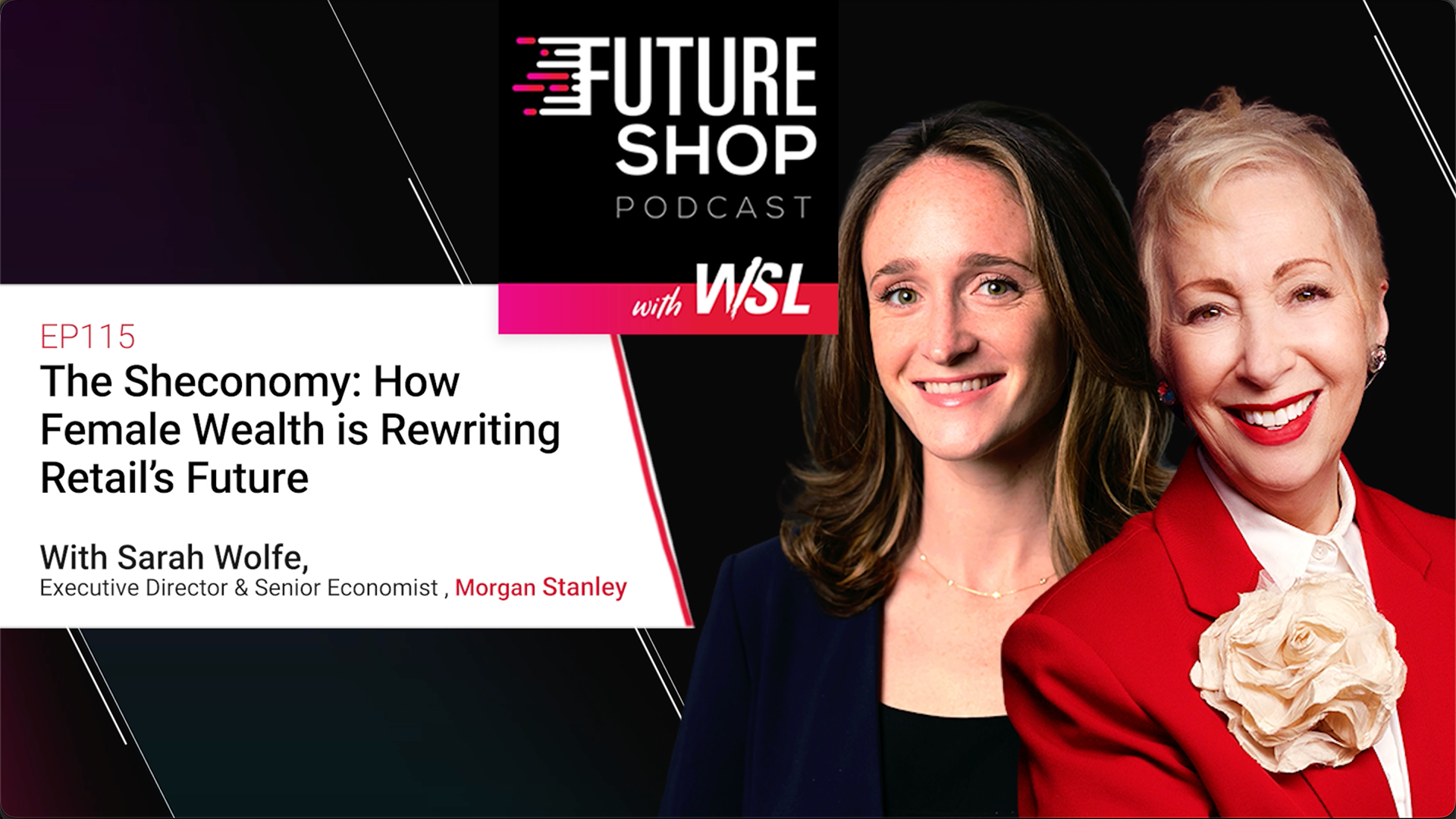
In this episode of Future Shop, Wendy Liebmann sits down with Sarah Wolfe, Executive Director and Senior Economist at Morgan Stanley, to unpack the economic reality of the “Sheconomy”. Moving past generic DEI narratives, Sarah grounds the debate in hard data—revealing how demographic shifts, delayed motherhood, home equity gains, and the massive interspousal wealth transfer are exponentially expanding female buying power. From the rise of the single female consumer to the strategic intersection of women, longevity, and AI tools, this conversation reveals why understanding the modern female shopper is a non-negotiable imperative for retail brands and investors alike.
Episode Highlights
- Data over DEI: Why the female economy must be treated as an economic imperative rather than a checklist exercise.
- The Motherhood Penalty & Time Tax: How unpaid labor and career timing impact wage gaps, and why single women are driving distinct retail trends.
- Wealth & Real Estate: Women’s housing equity outpaces men’s by 24%, setting up a massive shift alongside the $124 trillion generational wealth transfer.
- AI & Reskilling: How female consumers are beginning to use AI to automate daily tasks and why women are well-positioned to adapt to AI workforce shifts.
Chapters:
00:00 – Grounding the Sheconomy in Economic Data
04:22 – Homeownership Equity & The $124 Trillion Wealth Transfer
10:41 – The Motherhood Penalty, Time Tax & Childcare Costs
17:03 – The Power of the Single Female Shopper
18:52 – AI Adoption, Reskilling & Holistic Wealth Management
31:19 – Demographics, Future Trends & What Retailers Must Do
Don’t miss upcoming episodes, subscribe to our podcast with your favorite app.
Watch the video episode:

sarah & wendy_sep_final Tue, Oct 27, 2026 10:21AM • 38:10 SUMMARY KEYWORDS She Economy, Retail trends, Economic data, Female empowerment, Wealth transfer, Housing equity, Motherhood penalty, Wage gap, Unpaid labor, Childcare costs, Single females, AI adoption, Longevity trends, Wellness economy, Consumer behavior SPEAKERS Sarah Wolfe, Wendy Liebmann Wendy Liebmann 00:09 Hello everyone, I'm Wendy Liebmann CEO and Chief Shopper at WSL Strategic Retail, and you know it, this is Future Shop. Today my guest is Sarah Wolfe. Sarah is a fascinating person for many reasons, but she is the executive director and senior economist at Morgan Stanley, the financial services and investment company. And she has a an illustrious career there over the last seven years, before that was at the World Bank. So she brings a unique perspective to the future of retail and I am delighted to have her with me. Sarah, welcome to Future Shop. Sarah Wolfe 00:47 Thank you for having me on, Wendy. Wendy Liebmann 00:50 I met Sarah through one of her colleagues, Hilary Goldsmith, who I met through Diana Melencio from XRC at an investment dinner and we kept talking and then all of a sudden she said, You need to meet Sarah and there you go. So there are lots of you know, lots of connections here, but but the reason I was delighted to meet Sarah everyone is that she has authored a piece of work at Morgan Stanley entitled The Sheconomy and those of you who know me know I am very passionate advocate about women of for many multiple reasons. And this is a fascinating piece of work. She came to speak at our women's wellness symposium in the summer this year and was a great success because she grounded the economic imperative of why we need to think about women not just as it surrounds wellness, but in many ways. So anyway, after that long, long introduction and six degrees of whatever's. Sarah, I'm thrilled to have you here. Before I get back into the into my chat with Sarah, you know the thing, you know the ask. Don't forget, please click sign up, subscribe to this podcast so we know you're there wherever you get your podcasts. I know I'm always nagging, but makes a difference if the numbers are there. So thank you for that. Now on to my conversation again with Sarah. Tell me a little bit about what precipitated this work. Sarah Wolfe 02:16 The Sheconomy work was precipitated because we didn't want the female economy and the importance of it to just really be about, let's say, DEI or because companies feel like they have to do it, but to really rooted in economic data that this is and will continue to become the most important buyer in the global economy. And there's a lot of structural forces that are happening at the same time that are only going to exponentially grow the power of the female economy. And I remember reading some statistics and I don't have them off the top of my head, but something along the lines of, you know, women are 70% of shoppers, but they are one to two percent of CEOs. And so you have all these companies that are led by men with teams of men all the way through the board level, right? that are not relating to the woman shopper who's actually the one buying for herself, whether she's single or buying for her whole household. And there's a really big problem with that. And so this report frames that debate in the economic data. Wendy Liebmann 03:30 Yeah, I love that. It it sort of totally eliminates any of the emotional bias that might come with it by really sort of, you know, give me the facts, ma'am, if you will. And I think that's what resonated so much with people, certainly at our at the symposium. but also I think more broadly, as I you know, as we've talked about it and shared the conversation, you know, sometimes if you've been around a long time as I have and you keep talking about women and you know, women as the, if we don't get it right for women, we get it right for nobody, kind of thing in the family, caregivers, all of the above. So that's why I found it so fascinating. Tell us a little bit about how you did the study and is this unusual for Morgan Stanley to do a piece of work like this, uncovering an an opportunity or is this something you do all the time. Sarah Wolfe 04:22 So in my role, we we cover the economy and we cover thematic investing. And typically we're focusing on AI infrastructure and AI adoption and global supply chains and tariffs, things, things of that nature. and less attention tends to be given to one of our themes, which is called societal shifts, which is all about what are the slow moving forces in this society globally, whether it's aging population, immigration trends, longevity, the Sheconomy that are really kind of like these slow moving drivers of global growth that are happening in the background that are maybe a little bit less sexy than AI adoption or you know some of these semiconductor companies. So in that sense it is a bit unique because it's part of a theme that gets a little bit less attention. But what started the the thesis is with my economics hat on I'm always looking at the government data, right? We're looking at the data from the Bureau of Economic Analysis and the Census Bureau and the Bureau of Labor Statistics. And what we saw was a few different trends happening among women and happening at the same time that increases their power. So the first is that they're earning longer. Women are staying in the workforce for longer. And they're not just staying in the workforce for longer, they are choosing to get married and having children later. Which means that they're getting these maximum earn more maximum earning years in. And we'll talk a little bit more about that motherhood penalty that I discussed at the conference. But they're earning longer, they're having children later, so they're getting less of that motherhood penalty. And so their buying power is increasing through that channel and their influence in the labor market is increasing. and then on top of that, there's this whole wealth component. They are building and inheriting wealth in a way that we've never seen before. And I start with building because you know, shockingly, and maybe it shouldn't be shockingly, but it shocked me the data, women, in particular, single female, are on par with single men in terms of home ownership rates. It's 50-50. But what's amazing is that the value of a woman's home is 24% higher than the value of a man's home. They are buying homes of higher value and building more equity and investing more in their homes. So they're building wealth through that channel. And then we have this great wealth transfer that where everybody's talking about. I mean, I work in the wealth management space, so it's all about the wealth transfer, but the baby boomers are aging and are sitting on $124 trillion of wealth. and that money is about to start moving hands. And one of the interesting things we're going to see. Is this interspousal wealth transfer that women 95% of the time outlive their husband by an average of five years. And so a lot of that money is going to be moving from the husband's hands, typically, because they're for the most part part of that financial conversation, managing the money to their wives' hands and then to their children. That's going to help them build even more wealth. So you can see how these different things are compounding and increasing, increasing power of women in the economy and that's only going to be growing in the coming years. Wendy Liebmann 07:48 Yeah. So does that, as you, cause I know the practice you focus on is is wealth management. Is this as you looked at this, is this power of wealth relegated to people with higher income jobs, lots of income, all of those things? I mean, what about, you know, the half the population in this country I think is below household incomes of fifty thousand a year? Are you also seeing that incrementally change for women? Sarah Wolfe 08:20 So great question. So the housing wealth channels where this becomes increasingly important, where while equity wealth is the most concentrated asset among upper income households, the top 20% control over 70% of all equity wealth. So there is concentration there. The housing channel is the most evenly distributed across the income distribution. So the fact that women have made a lot of gains in the housing channel is is significant because they're building wealth and moving up through that way. and then the fact that they're pushing out their marriage and childbearing years so that they have more time to move up within the labor market allows them to also build wealth and equity and build 401k plants. And that's where actually most of the wealth has been coming through, right? We've seen just in the past five years. Equities are up $55 trillion. I mean, it's kind of hard to even say a number like that. What does $55 trillion even look like? but if you if you're in the workforce and you have a 401k, you have been benefiting from that money as well. So there is obviously this distributional and inequality component, but we are seeing that women are making gains despite that. Wendy Liebmann 09:40 Yeah. It's really interesting you say that because we have two on our team, one both in their I don't really know how old they are, late forties, maybe early fifties, as single. and they both have their own homes. One a two family home that she bought you know, coming out of COVID a little before, and the other who just purchased her apartment. And I think that's that's very reflective of what you were saying in terms of you know, their their the equity, the the wealth that they have and the 401K plans and and and that too. That's it's very interesting. That becomes very real to me. I can see that even within our, you know, own own organization. yeah, so that's that's quite encouraging. It's not just the rich getting richer, it's the opportunity for for women as they both age. You you raised the point of the the you've got a better term for it than but the baby gap, that's not really the what is it? What's the term you you use instead? Sarah Wolfe 10:39 the motherhood penalty. Wendy Liebmann 10:41 Yes, the motherhood penalty. Well, that's tough. Talk about that a bit more, and the implications of that, and and delaying having children. Sarah Wolfe 10:49 Sure. So the reality is is that even in a place like America, where, you know, we think that we live in a in a country of equality, there's still a wage penalty to women. they still make about eighty to eighty-five cents on the dollar relative to men. and there's a few things that are driving that. The first is the time tax, that women perform three times more unpaid labor than men do in the US, but this is also in the global economy. I mean, some countries are even worse. It's really bad. And what is unpaid labor? Unpaid labor is cooking, cleaning, dropping your kids off at school, taking care of the grandparents, taking care of your neighbors, right? All of these things that take up hours in your day that you're not making money for. They do women do three times the amount of that. And so that, right, inherently means that some of that time is coming out of paid labor. Right, or could be coming out of your performance at work. and that is built into the wage penalty in some ways. But then the other one comes from Claudia Golden's research. She won the Nobel Prize in Economics a few years ago for her incredible research on women in the economy, and it's what's called a motherhood penalty. And it also is tied to this idea of the time tax, but when men and women enter the workforce in the US, they actually there's not really much of a wage penalty between men and women. They come in nearly at parity now in the US. And then that compounds over time as you become a mother. So a mother relative to a non-mother, once they've had children, actually has about a 20 to 30 percent wage penalty. So it's even within women, mothers versus non-mothers. and then mothers versus fathers, the wage penalty is between sixty to eighty percent. I mean, those numbers seem crazy to me. And so what's happening there, it's the unpaid labor, it's not taking those promotions, not taking those big career jumps that are gonna take up more of your time and make your life less flexible because you feel like you need to do more at home. But it's also the flip side. It's what we call the fatherhood benefit, the fatherhood premium, where when you become a father, companies think that, you know, you're stable, you're gonna work hard for your family, you're gonna put your job first to provide for your family, and you get paid more and get more opportunity. So it's the benefit to becoming a father and the penalty to becoming a mother. And and you know, myself becoming a mother just about a year ago, and loving my job and my career, but y I feel it. You feel the mom guilt, you feel the pull. Right, to be home and spend more time with your children no matter how much you want to work and love your job. Wendy Liebmann 13:33 Yeah. Yeah, I was talking to somebody recently she works with a privately held company where there's some flexibility, but the CO founder wanted her to take on a an even more important role and she said, I cannot do it until my children are in university at college. She said, I just my commitment is I will not. I will do everything I can, but I wanna be around for them. They just went to university. So she is like, Okay, ready but you know, if she was in a public company or a larger company, that may not have, you know, there may not have been that flexibility. So again, the examples you're sharing really come to real life when you think about it. And then there are the people who are taking care of the parents, right? The caregivers that we talk more about and the implications of of all of that. so I I all of those things, you you just you raise the point about global versus US. Is this I I know some of the data is global data that you shared with us at the conference. is that is the US particularly similar or different to certain parts of the world or is this a pretty common story as we go around the world? Sarah Wolfe 14:43 I mean it's a common. It's really a common thread across the world. If I look at some of the countries that are doing it the best, it's it's some of these like northern European countries, like Sweden, even like Estonia, I'm looking at some of the charts right now, Norway that have kind of the the best sharing of work between men and women. but you look at other countries like Greece, Japan, Korea, Turkey. I mean, it it's real Italy. I mean, for for the most part, this is a global phenomenon. And there's no country where men are doing more unpaid work than women. There's, there's no premium example. And what I wanted to also follow up on this point is, and this is a little bit more specific to the US, is how ch the cost of childcare starts to factor into all of this as well, because it's a little bit of a double-edged sword where because childcare has gotten so expensive, even with the wage penalty that women face, they still have to work. It's much harder to have a single-earning household because the cost of having a family is so high that you really need a dual-earning family. And if you look at the women's workforce participation rate, it's been rising over the recent decades. It had an amazing post-COVID recovery, whereas male participation rates have barely recovered. So there's some really great stuff in there. Like women are in the workforce, but some of it is because they have no choice. Some women may want to stay home and not have to work. but the cost of childcare is literally now the second mortgage because in 45% States sending two kids putting two kids through childcare is more than a mortgage. And in forty nine states it's more than rent. So it really changes the dynamic of how women are able to spend their time and if they wanna want to be in the workforce or not be in the workforce. Wendy Liebmann 16:43 Yeah. So talk a little bit about the the now the the fact that women tend to get married later, have children later. How is that because that single perspective is fascinating, particularly as we think about the more mundane things of retail and shopping and all of those sorts of things Sarah Wolfe 17:03 I mean I love this because this is actually, I think, maybe the most important part of the Sheconomy is the single female. because if you look at the broader female population, it's growing about by about 0.8% a year, but the single female population is growing by 1.2%. So we're seeing it growing faster because people are getting married later, they're deciding not to get married at all. and the single female looks a lot different than the married female. They are not spending money on child care. They don't need to spend as much on a home. They less on groceries, education, right? They have this discretion to spend money how they want. And what we see is that they still care a lot about their housing quality. We talked about that earlier. They spend more on personal care, on wellness, on experiences, on dining out. And as this group continues to grow, retailers need to make sure that they are tailoring their products towards this powerful growing female cohort, the single female economy. Wendy Liebmann 18:04 Yeah. It's interesting. the other day, you know, just with working with clients and a number of them still focus so much on busy families, busy mums. And and you know, I get it, of course. But having, you know, read your research and then heard you speak, that was the thing that I kept saying to myself, okay, now what would that look like? What does that either big box or healthcare store or specialty whatever store? What does that look like if you say I've got, you know, X percent of a target that lowercase T that I think I could really attract? And what would that look like? So are you seeing companies, retailers, brands thinking about these things as you now have this this encouraging or this fascinating framework? Sarah Wolfe 18:52 This is where I think AI becomes quite interesting actually, because with women spending so much time on paid labor and unpaid labor and they're pulled in a million different directions, they need help automating a lot of these mundane tasks and just making their lives easier. I mean, myself as a mom, like I feel like I outsource a lot of my decision making and, and knowledge to to to my my Claude app on you know what is this can you help me with this can you help schedule this that and the other or plan this so I do think that companies that are thinking about how do you leverage AI to help this specific cohort save time and increase what we call their consumer surplus, the benefit that they're getting to their personal lives from AI. I think that's really interesting. So I think about a company like Walmart, right? That has their Sparky tool that is basically like an an AI agent that helps you shop for everything you need. Like that type of tool cuts down the top the task and the responsibility of grocery shopping and doing back to school shopping exponentially, right? So I think the the the companies that are using AI in that way, I also think that understanding, you know, that the wo- the female consumer is not just one body. It is so different and heterogeneous, whether it's the single, young, single female, whether it's the married mother, the single mother, or it's the woman entering retirement, but having you know a long, healthy and active retirement and wants to have fun and travel and play sports to the next level of retirement that requires a little bit more assisted living and less mobility. to think about, you know, that women in every stage of their lives have different needs and want to spend their money in different ways and that they should not be viewed as one blanket cohort. what do women want? As we all know, we all want different things. We're very specific. Wendy Liebmann 20:57 Right. Right. Right. Yeah. And and to your point, you know, if I'm single versus married or in a relationship, if I then add kids onto that or parents onto that, that's a different life style, chosen or not. And that too helps uncover or uncouple some of those other opportunities. It's it's what I feel like I've been living what you're talking today. I was at a at a meeting and somebody said to me that they had just started using their own agent to really coordinate their lives because kids going back to school, you know, work stuff and pressure there, board receptive, whatever. And that they had just created their own agent. I forgot to ask what her name was, but I assume it was a woman name. And and basically that was here's what here are the menus for the week, you know, here are the click here, here are the ingredients you need for the menus for the week, here are the, you know, have you got the school list, birthday party coming, you know, all of those things. And you do realise in this moment when half the world is saying, my god, stop the AI and on the other saying, my god, yes, please let me save time, that that can become a a tremendous tool in in all of this. So I feel like as I say, I've I've lived your study this last twenty four hours and all the people I've been talking to. the other thing that strikes me that you raised is also this discussion we had at the at the conference about longevity, wellness, how do we both with and without financial security, how do we help think about the women about women and how they will choose their to take care of themselves potentially, even if they are in a relationship as they get older, as because they live five years longer, I think you said. So how do you see that? How are you seeing that come when you look at the spending from an eco economist point of view as people get older? Is it different communities? Is it different support structures? Are you are you s are you able to tease that out yet, or is that too soon in terms of how women are spending their money? Sarah Wolfe 23:08 No, it's a great question. I think it gets to this wealth question as well, is that if women are going to be, you know, entering their retirement years and living longer and and and also controlling more wealth, how do they like to spend their money and how do they like to invest as well? and this is important, you know, I I I work at a financial institution, so we're always thinking about how can we better serve our female. clients and make sure that they're supportive because the reality is a a majority of women are not part of the conversation. They're not part of the financial planning conversation. They're they don't have a relationship with their family's financial advisor. And the the reality is that often when their spouse dies, they they switch advisors because they're not part of that conversation. And so I think when when we look at longevity, there's a couple of things. First of all, as we live longer it's more and more important that you're planning for that future, right? You're planning not necessarily for a ten or fifteen year retirement. You could be planning for a twenty to twenty five year retirement. That looks really different than ten to fifteen years. how do they like to be supported in that relationship? And we find that this model like financial planning versus just investment advice is much more effective. Women like to think about their finances much more holistically than, you know, am I just am I investing in this company or that company? They're much more steady. They want to think about, you know, will I have enough money to you know buy this home or send my kid to college and will it allow me to do these trips? Like they want a more holistic value proposition. And then they like to invest differently, lower risk, which actually turns out to be better. Women are better investors than men. They get higher returns on their investments because they're not trading with the market. they care more about philanthropy as well. That's a really big difference that we're going to see more money going to philanthropy as more money is controlled by women. And so that's going to be really interesting for the broader economy as well. Wendy Liebmann 25:09 Yeah, that that's that's fascinating. There so there clearly is the Mars Venus thing that some some some of us talked about years ago and I found myself using those that example the other day and somebody of a Gen Z generation said, what? What is Mars and Venus? And I said, Well, you know, men are from Mars and women are from Venus or whichever way that goes. so it was just interesting thinking about that, the the way we think from a societal perspective, I guess, in terms of everything in that. So so what were the biggest as an economist, and I'm fascinated by the work you did when you were, you know, pre Morgan Stanley at the World Bank, when you step back and think about all this, what what were some of the surprises that came out of this work? Sarah Wolfe 25:55 I mean, as I mentioned before, that the housing component surprised me. I don't know why it did, because in my home I'm you know, with between my husband and myself, I'm the one that makes sure the house looks nice and is furnished with nice things and is aesthetically beautiful, right? so I don't know why it surprised me, but it it just did and it was really promising to me that like women have this channel that they're building wealth and that they're investing in. The other thing that surprised me is that that when women invest they outperform even though they tend to have much lower financial literacy than men and understand markets less, but maybe that's to their benefit because they kind of buy and hold. the other thing that surprised me is kind of like the flip side of the AI story, that women have much less digital skills and literacy than men and are actually, likely to be more in AI disrupted sectors than men. Some of these more auto tasks that can be more automated, like customer service agents or retailers, for example. But what when I saw that debate, I kind of think of the flip side of that, where if we look at the COVID pandemic, we saw mass layoffs in leisure and hospitality and retail trade. A lot of these very female concentrated jobs. but it did not stop women. They reskilled themselves and they went back into the workforce and they took other jobs in construction and manufacturing and working at the front line. And I mean, it was truly incredible. And the opposite happened for men where they lost their jobs in mid career, they weren't willing to reskill and learn a new profession. And so I see this AI story as we could really see the other end of it if companies and perhaps also the government are willing to invest in training women to have these new AI schools and use skills, these tools, then they could be the best equipped to learn these new professions with a healthy amount of skepticism. Women are less trusting of AI, right? Because we're very truthful and we'd like to know everything with great certainty before we talk about it. And sometimes when you ask AI for an answer, then you repeat it, you're like, do I really understand that? Do I really know what I'm talking about? So women are the right people to ask the hard questions and to learn these new jobs, I think, in a world of AI. So that was a surprise, but then also like a a bit of a pushback, 'cause if we look at history, women have been very dynamic in the workforce. Wendy Liebmann 28:26 Yeah. I think that you know, you just you just as I as I think about women for whatever reason, our adaptability, whether that's necessity, something happens and we have to adapt, whether it's, you know, thinking about taking care of, as I say, our kids or our parents, grandparents in communities, that community led kind of engagement and that adaptability to me is really fascinating. And also you're right, the challenge to new technologies is this, is it right? Or isn't it right? Or I'm happy to ask directions, that sort of that sort of commentary as opposed to, you know, never ask somebody we always say about the men in our lives. they never they're never willing to ask directions. so so some of those things seem to be holding true in all this, which which does make it really interesting. I also thought to your point about flip side, as I think about the industries where I might call it the laying on of hands industries, the service industries, I was at the little spa I go to the other day and and the the facialist always she and I always have this conversation, how's your business? How's your business? And she said, you know, it's really interesting. I don't think yet we're going to see robots doing a facial or a massage, maybe, but not, you know, in the near future. and so she was talking about those kinds of businesses where there is opportunity for women that technology may not disrupt quite so soon. We'll see. We'll see. Sarah Wolfe 29:58 It's funny that you bring it up because in like in the US, only five percent of the US population thinks that like AI robots are like a good thing. But if you go to China, it's like sixty percent think it's a good thing. So we just have this like maybe it's 'cause of the terminator, we have this like natural skepticism of embodied AI in the US. And and I think about it myself, everybody's talking about embodied AI in the healthcare industry and you know doing elderly care and things where I'm like, I don't know if I would let a robot hold my newborn baby instead of, you know, having a real nurse help. So I think that we have a long road ahead of us before we replace some of these jobs that women have a lot of representation and value in. Wendy Liebmann 30:44 Yeah, yeah. Yeah, but to your point, we have this map now I'm putting my very poor three years of economics hat on. you know, if we can't if we don't have the coverage in hospitals, in care centres, then you know, maybe we're driven to having more robots do certain things and, you know. So who knows? You and I will talk about that in two or three or four years and and see where all that takes us. I think, you know, as we as we sort of wrap this up, what are the things we really should pay attention to here that are both opportunities and potentially concerns if we don't get it right? Sarah Wolfe 31:19 I think that it's important to just be rooted in what the demographics are showing us. because that is gonna define what the female economy really looks like, the composition. So, are we continuing to see this upward drift in people getting married later and having children later, or does that start to reverse? Right. I've gotten a lot of questions and I think with like this kind of like traditional wife movement, like, are we actually seeing the trend reverse and people are getting married earlier and having more children? That's not showing up in the data, maybe just more on TikTok. but being rooted in the data, what are the demographics telling us? Are, you know, when are people entering the workforce? When are they leaving the workforce? What is their wage penalty? and that helps us understand what the different segments are of the female economy so that we could properly tailor our products. for them and target them in in a way that they really want to buy and shop. I think that's just it's just so simple as simple as that of understanding who different women are and what they need. Wendy Liebmann 32:26 Yeah, yeah. And and staying close to that. You know, as you said in the beginning, as an economist, you you look at those demographic trends, and societal trends I think the other thing that struck me about this report and some of the things you said in it, was it felt very grounded and I think when you and I were when we were preparing for the for the conference and you were so good at sort of synthesizing the key messages, they were so potent for people because I think even if the audience, you know, like I was using examples of knowing people who were in this or that, they hadn't really seen it in that very practical database way that made them realize the the sort of scale of it. And I think that's what that's what this report to everybody as you think about this, the scale of this is what makes this so so powerful. And then as a benchmark to keep an eye on as we as we move forward. So that's that's why I was so in impressed with it on a day to day basis. So what's on your radar for twenty twenty seven, twenty twenty eight and women now that you're a mum of a little one? And from a work standpoint. Sarah Wolfe 33:42 I'm curious about how some of this some of these trends of women in leadership start to pan out i mean we've seen consistent rise of women leadership across government across the senate legislat legislator across you know ceos at S&P 500 comp companies so tracking that because that's really about influence right we want to see that rise so are we seeing women have increasing influence there looking at what's happening under the surface from a demographic standpoint and you know how is female empowerment shaping out among black women, among Asian women, among Hispanic women, right? Are they also benefiting from this rise in female empowerment? so th those are some of the things that are gonna be top of mind that I think are also areas for for more research on the topic. Wendy Liebmann 34:35 Yeah, yeah. And I do think this being a woman owned company that we are, I think the numbers are are still quite dynamic about the percentage of small businesses that are started, founded, whatever by women and that sort of growth on the small independent business side of women who either have to find a different way to be employed, different kinds of things. I see it in the beauty industry particularly. I was just at a board meeting this morning and I think about the all the the women founded startup companies that have you know, in that in the beauty business that that have begun there. So I that's the other thing I'm keeping an eye on as well. How much that that drives some of the economic improvement and scale that you're talking about. So that's that's on my list. So I hope we have the chance to revisit this in should we do it twelve months or do we have to wait two years? What do you think? Sarah Wolfe 35:30 Okay. I'm dying to do some work on the wellness economy, so maybe we could come back on once that Wendy Liebmann 35:35 Yes please. Yes, please. Because you know that's another passion. And I think that's also the area where women have both tremendous need. In our la latest research, and it was thirty percent of women said they feel very underserved when it comes to their health and wellness. So that's a massive opportunity. So Sarah, thank you for this. Thank you for sharing it. And I look forward to following the Future Shop conversation around wellness or Sheconomy. Sarah Wolfe 36:02 Thank you for having me, Wendy. This has been awesome. And the wellness event, I thought it was one of the coolest conferences I got to go to. Wendy Liebmann 36:09 We loved. We loved to have you at that. Thank you, Sarah. Good to have you. Cheers for now. Sarah Wolfe 36:15 Thank you. Wendy Liebmann 36:15 You know, I think it's pretty clear there is so much data that points to the opportunities of this changing female landscape. You know, sometimes we we sort of joke about it or we think about women as part of the busy household, families, caregivers. But this growing number of women in the population in the US and around the world who are single longer, building wealth. And by wealth, we don't mean billions and squillions, but building their own personal wealth through real estate investments, 401ks, changes the way they think about their spending for a longer portion of time, changes the emphasis, whether it's travel or services or home, personal care. Understanding that data is really, really important as we move forward because if we still have this image of women the way perhaps our mothers and grandmothers grew up, and even our older sisters grew up, that may be masking an untapped opportunity and a reality of when we say, is the shopper in the room do we know who that shopper really is? So the conversation I found so rich and it was also very rich at our women's wellness symposium called The Next Revolution. But the future is in the hands of women, as you've probably heard me say before, so please, attention must be paid. See you in the future. Cheers for now.